
How Playing in a Chamber Orchestra Teaches the Brain to Multitask
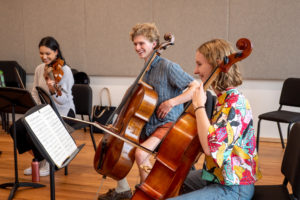 What if playing music could help your child become a better listener, a more focused learner, and a stronger team player?
Learning an instrument already challenges the brain in many ways. But playing in a chamber orchestra introduces an entirely different experience. Young musicians must listen closely to one another, follow musical cues, coordinate their movements, and adjust their playing in real time.
Unlike larger orchestras, chamber ensembles often feature smaller groups of musicians, giving each player a more noticeable musical responsibility.
Every note matters. Every entrance counts. And every musician contributes to the overall sound.
Beyond making beautiful music, playing in a chamber orchestra provides young musicians with opportunities to exercise important cognitive skills that can benefit their development both inside and outside the rehearsal room.
Let’s explore how!
1. Every Musician Must Stay Actively Engaged
In a chamber orchestra, musicians cannot simply rely on following the larger group. Each player has an important part to contribute.
A violinist, violist, cellist, or other instrumentalist must pay attention to their own musical line while remaining aware of what the other musicians are playing.
For example, a young cellist may need to maintain a steady rhythmic foundation while listening for a violin melody or responding to a change in musical expression.
This requires the brain to process several layers of information simultaneously.
Through this experience, children practice:
- Active listening: Paying attention to the musical ideas of others.
- Concentration: Staying engaged with their individual part.
- Coordination: Aligning their playing with the ensemble.
- Musical awareness: Understanding how their contribution fits into the bigger picture.
In a chamber orchestra, being a good musician also means being a good listener.
2. Chamber Music Strengthens Attention and Focus
Playing in a smaller ensemble requires a high level of awareness.
Musicians must recognize musical cues, watch the conductor or ensemble leader, listen for entrances, and respond to changes in tempo, dynamics, and expression.
There is less room to lose focus because every musician plays an essential role.
During rehearsals, young musicians learn to:
- Follow musical instructions and cues.
- Recognize changes in rhythm and tempo.
- Concentrate while other instruments are playing.
- Maintain attention throughout a musical passage.
- Adjust their performance based on what they hear.
These experiences give children opportunities to practice sustained attention and develop stronger listening habits.
3. It Challenges Working Memory
Working memory is the brain’s ability to temporarily hold and use information.
Chamber orchestra participation puts this ability into practice throughout every rehearsal.
Imagine a young violinist preparing for a musical entrance. They must remember their notes, keep track of the rhythm, listen to the other instruments, and recognize when it is their turn to play.
All of this happens within a musical conversation that is constantly moving forward.
Musicians also receive feedback from their conductor or ensemble leader and must remember those instructions when practicing the passage again.
Research on instrumental music training suggests that structured musical activities can support the development of working memory and other cognitive abilities.
4. Musicians Learn to Adapt and Think Quickly
Music is not always predictable. A conductor may introduce a tempo change, another musician may take a phrase in a different expressive direction, or the ensemble may need to adjust its balance.
Young musicians learn to respond to these changes while continuing to perform their own parts.
This exercises cognitive flexibility: the ability to adjust thinking and attention when circumstances change.
In a chamber orchestra, children practice:
- Listening to the musical direction of the ensemble.
- Recognizing changes in timing, dynamics, or expression.
- Adjusting their individual performance.
- Staying connected with the other musicians.
These experiences encourage adaptability and thoughtful responses rather than simply playing notes from a page.
5. Individual Responsibility Builds Confidence
In a large ensemble, it can sometimes be easier for young musicians to blend into the group. In a chamber orchestra, individual contributions are more exposed.
Each musician has a responsibility to prepare their part, participate actively, and support the ensemble.
This helps children understand that their efforts make a difference.
As they become more comfortable performing with others, they can develop greater confidence in their abilities and learn to take pride in their musical contributions.
They also discover an important lesson: being part of a successful ensemble means knowing when to lead, when to support, and when to listen.
6. The Benefits Extend Beyond Music
The skills developed through chamber orchestra participation are useful in many aspects of everyday life.
Concentrating on multiple musical elements, remembering instructions, responding to others, and working toward a shared goal all provide opportunities to exercise cognitive and social skills.
These experiences may support children’s development as students, collaborators, and independent thinkers.
Although music education does not guarantee improved academic performance or make children natural multitaskers, research suggests that structured musical training can benefit certain aspects of cognitive development.
And perhaps most importantly, children get to develop these skills while enjoying the experience of making music together.
Give Your Child the Opportunity to Grow Through Chamber Music
At the American Youth Concert Orchestra (AYCO), young musicians have the opportunity to take their musical education beyond individual lessons and experience the rewards of ensemble performance.
Through chamber orchestra participation, students can strengthen their musicianship, develop active listening skills, collaborate with other talented young musicians, and discover the importance of their individual contributions.
Whether your child plays violin, viola, cello, piano, or another instrument, playing in an ensemble can be an exciting next step in their musical journey.
Ready to discover what your child can achieve through chamber music?
Explore the American Youth Concert Orchestra and learn about opportunities to develop musical skills, build confidence, and grow alongside fellow young musicians.
Learn more about AYCO and audition opportunities HERE